German WW2 mid-late war army (Heer) radio operator 1/16
October 8, 2026
Swedish 250 kg minbomb m/40 (4pc) 1/72
October 8, 2026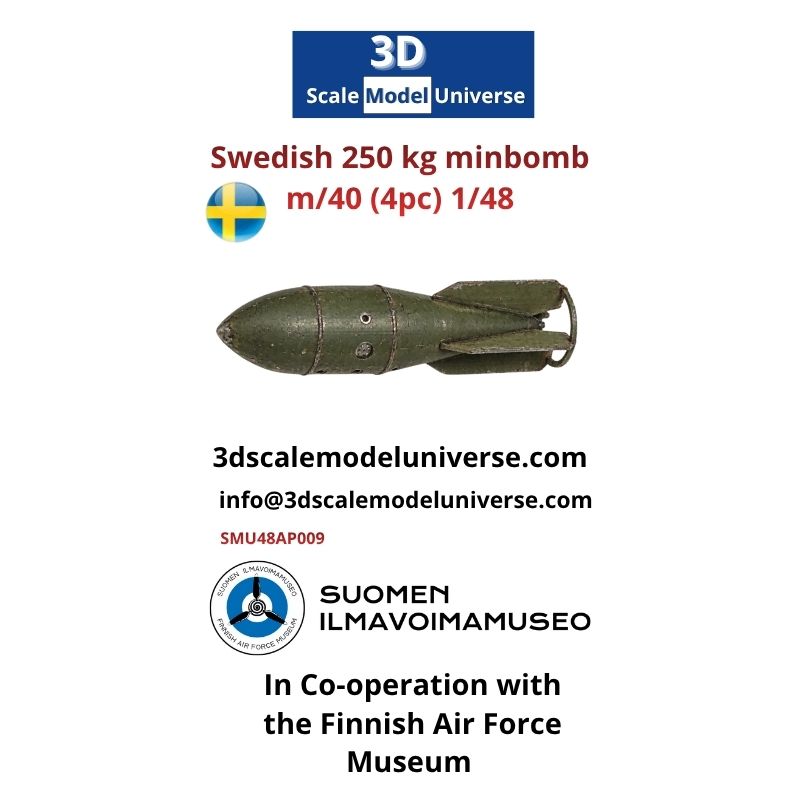

Swedish 250 kg minbomb m/40 (4pc) 1/48
Login to see pricesSwedish 250 kg minbomb m/40 (4pc) 1/48
Description
3D Scale Model Universe
Including 4 bombs.
The 250 kg minbomb m/40 (250 kg mb m/40) was a Swedish aerial bomb designed and introduced in the early 1940s. It was a pure mine bomb (minbomb), or blast bomb, meaning its destructive effect relied on a powerful shockwave created by the explosion rather than fragmentation.
Design and Operating Principle
The model was developed based on the earlier 250 kg minbomb m/37 bomb. The main external difference from its predecessor was its straight stabilizing fins (rakställda vingar), whereas the m/37 model had slanted fins (snedställda). The welded steel casing of the bomb featured five threaded holes: three for suspension lugs and two for guide pins, which were required when using the bomb with a dive-bombing crutch (bombgaffel).
The bomb was equipped with a central fuze (centralrör m/40 or m/41). This allowed the bomb to penetrate the ground, buildings, or ship superstructure decks before detonating.
Technical Specifications
- Total weight: 270 kg
- Length with fuze: 1,660 mm
- Body diameter: 370 mm
- Fin wingspan: 470 mm
- Explosive weight: 105 kg
- Explosive charge: Nitrolit (Nitrolit) (hexotonal was also used in later updates).
Usage and Carrying Aircraft
Two main versions of the bomb were manufactured: the live high-explosive bomb and a light grey painted, concrete-filled practice bomb variant (250 kg minbomb m/40 blind).
The bomb was used by the Swedish Air Force (Flygvapnet) during and after World War II on aircraft types such as:
- B 3 (Junkers Ju 86)
- B 5 (Northrop 8A-1)
- B 17 (Saab 17)
- B 18 / T 18B (Saab 18)
- A 21A-3 (Saab 21)
- A 32A Lansen (Saab 32)
Additional information
| Country | Sweden |
|---|---|
| Scale | 1/48 |
| Era | 1939-1945 |