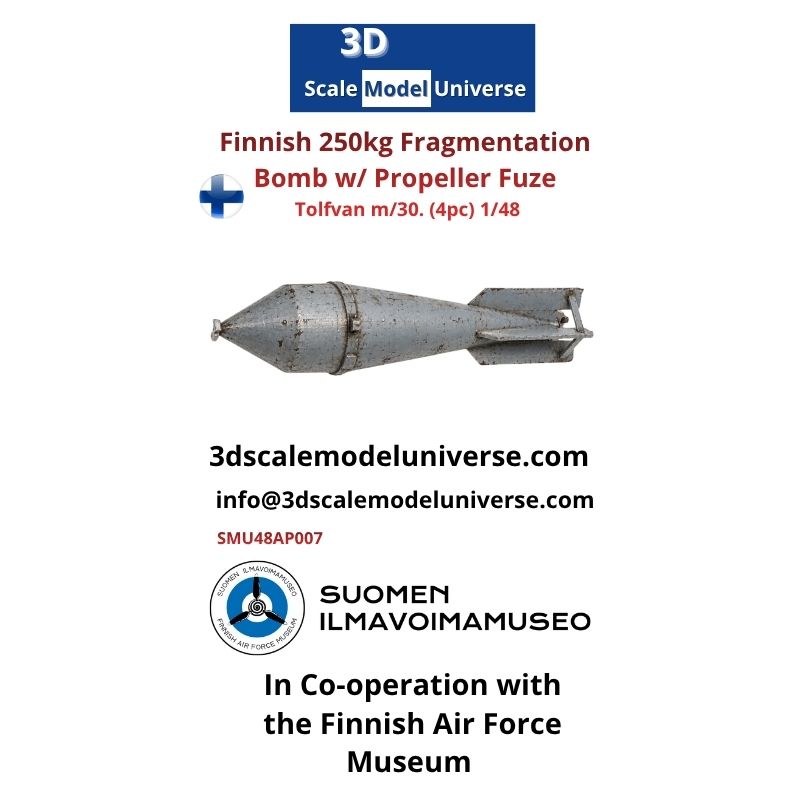
Finnish 250kg Fragmentation Bomb w/ Propeller Fuze Tolfvan m/30. (4pc) 1/72
October 8, 2026
Swedish 50 kg minbomb m/37 (4pc) 1/48
October 8, 2026
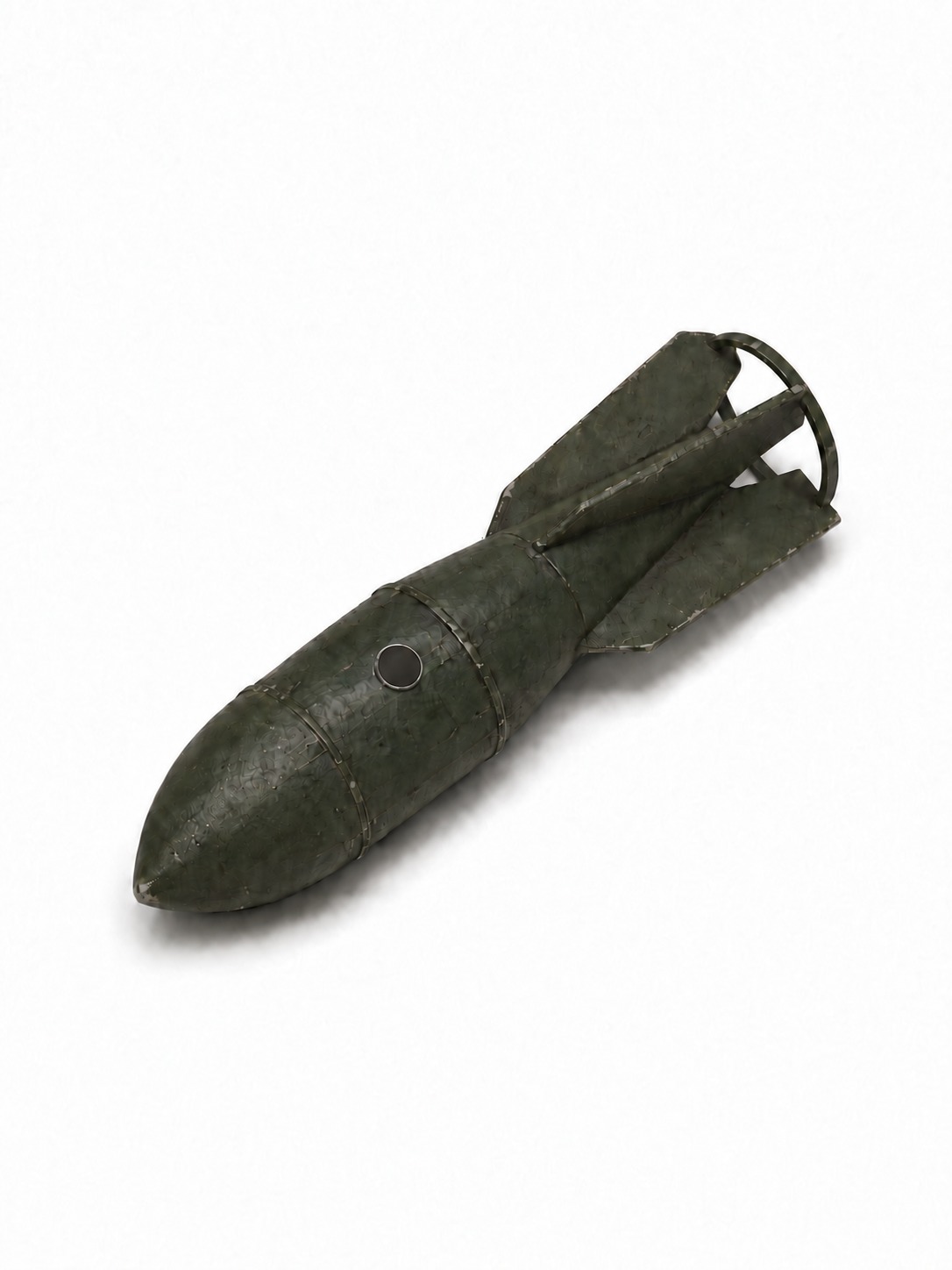
Swedish 50 kg minbomb m/37 (8pc) 1/72
Login to see pricesSwedish 50 kg minbomb m/37 (8pc) 1/72
Description
3D Scale Model Universe
Including 8 bombs.
Swedish 50 kg minbomb m/37 (often designated as 50 kg mb m/37A), a Swedish late-1930s aerial bomb designed purely as a blast bomb (blockbuster/mine bomb).
In Swedish ordnance terminology, a “minbomb” (literally “mine bomb”) is a blast bomb engineered to inflict damage through its explosive blast shockwave rather than casing fragmentation. Consequently, its steel walls are significantly thinner than those of a standard fragmentation bomb.
Design and Key Specifications
- Fuse System: The bomb utilized an internal central fuse (centralrör m/37 or m/40) embedded inside the main body. This design allowed the bomb to drill into the ground before detonating. The fuse could be configured with various delay times, enabling the bomb to deeply penetrate buildings or naval vessels prior to exploding.
- Body Construction: The weapon features a welded design consisting of four primary sections: a cast nose tip, the main body (cylinder), a tail cone, and stabilizing fins.
- Main Cylinder (Body): Made of a steel cylinder with a wall thickness of approximately 5 mm. It features three threaded holes for bomb eyelets, which were used for conventional vertical suspension inside aircraft.
- Nose Tip: The cast nose tip contains a threaded hole meant for a lifting eyelet or a protective plug. The eyelet allowed for “nose suspension” (spetsupphängning), which meant the bomb hung nose-up inside an aircraft’s bomb bay—a method uniquely utilized by the Swedish B 3 (Junkers Ju 86) bomber.
- Stabilizers: The tail cone houses slanted fins that are structurally reinforced by a tubular protection ring to prevent distortion or damage under high aerodynamic stress.
Service History
Introduced to the Swedish Air Force (Flygvapnet) just before World War II, the bomb served as standard payload for aircraft such as the B 4 (Hawker Hart) dive bomber and the B 3 bomber. Surviving evaluation models and training variants are preserved today in historical archives like the Swedish Air Force Museum (Flygvapenmuseum
Additional information
| Country | Sweden |
|---|---|
| Scale | 1/72 |
| Era | 1939-1945 |