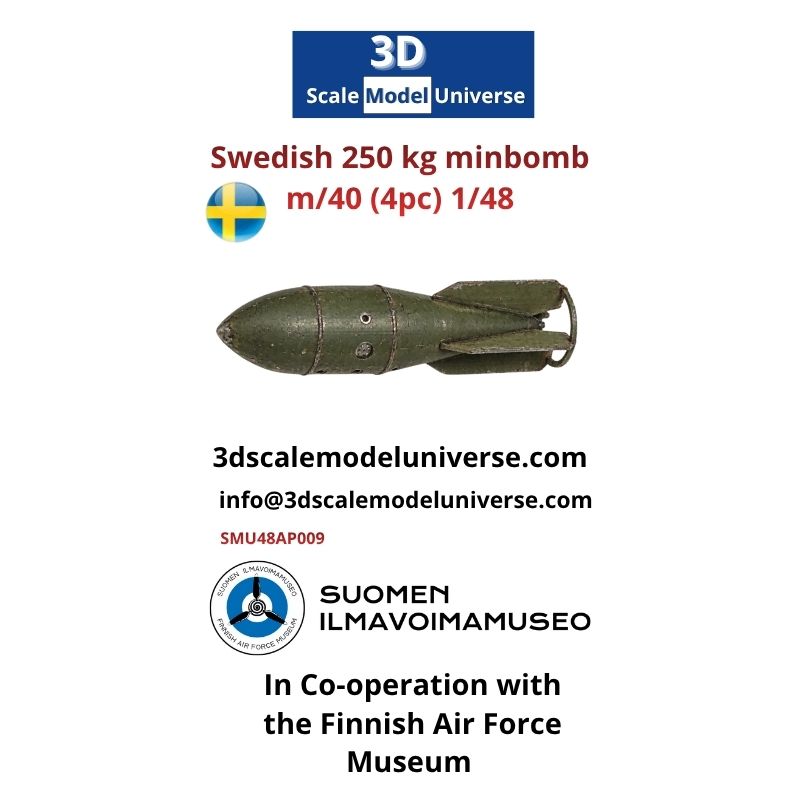
Swedish 250 kg minbomb m/40 (4pc) 1/72
October 8, 2026
British 112 lbs H.E. R.L. General Purpose / Heavy Case bomb (4pc) 1/48
October 20, 2026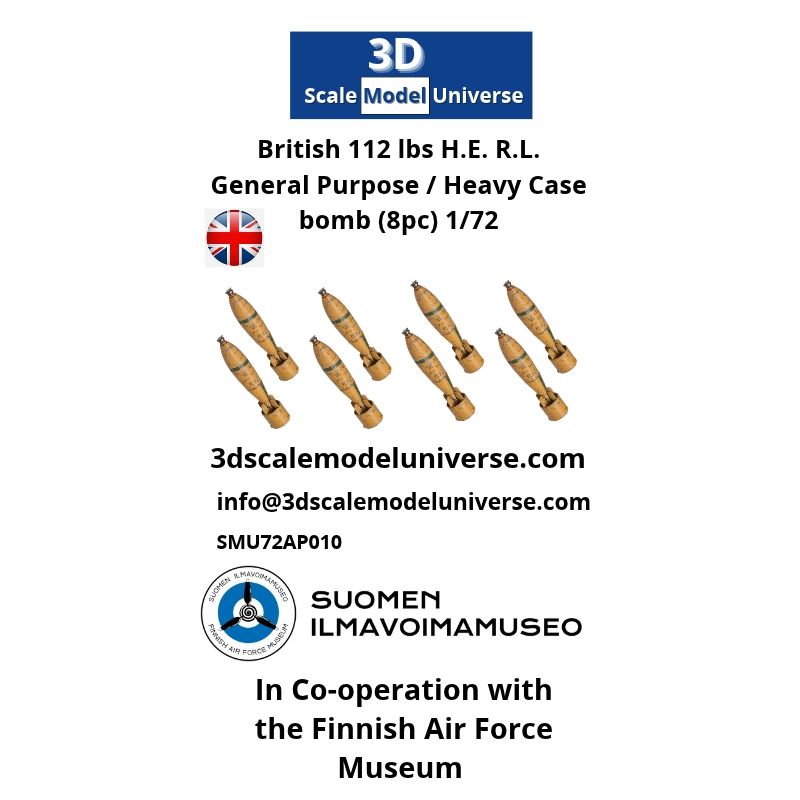

British 112 lbs H.E. R.L. General Purpose / Heavy Case bomb (8pc) 1/72
Login to see pricesBritish 112 lbs H.E. R.L. General Purpose / Heavy Case bomb (8pc) 1/72
Description
3D Scale Model Universe
Including 8 bombs.
The British 112 lbs (pound) H.E. R.L. (Royal Laboratory) General Purpose / Heavy Case bomb is an iconic piece of aviation ordnance with a long operational history spanning from World War I into the mid-1930s and World War II.
Here are the detailed technical specifications and historical context for the 112 lbs Mark VI and Mark VII variants:
Technical Specifications
- Nominal Weight: 112 lbs (approx. 50.8 kg)
- Total Actual Weight: ~116 lbs (52.6 kg) depending on the variant and firing arrangement.
- Explosive Content: Approximately 28 lbs (12.7 kg), making up roughly 24–25% of the total mass.
- Explosive Type: Typically Amatol (80/20 mix).
- Dimensions:
- Length: ~31 inches (approx. 78.7 cm).
- Maximum Body Diameter: 9 inches (approx. 22.8 cm).
- Casing Material:
- Mark VI: Made of Cast Iron (labeled with “C.I.” to signify material).
- Mark VII: Made of Cast Steel. [1]
- Fuzing: Designed with both nose and tail fuzes to ensure detonation even if the casing fractured on hard surfaces upon impact.
- Appearance: Features a steel, tear-drop shaped body with a nose fuze and four stabilization fins attached at the rear.
Key Historical & Operational Facts
- The “Heavy Case” / “General Purpose” Concept: During WWI, it was designated as a “Heavy Case” bomb used primarily for general purposes against material targets. Its heavy casing was specifically optimized to create lethal shrapnel and fragmentation or to penetrate the ground before detonating, rather than relying solely on blast wave energy (unlike “Light Case” or modern High Capacity miinapommit).
- Timeline of Service: Originally entering service mid-way through World War I (around 1914–1916) with the Royal Flying Corps / Royal Navy, it became a standard weapon carried under the wings or inside the internal bays of early bombers. Though officially slated to be phased out by newer 120 lbs General Purpose bombs in the mid-1930s, older stock was widely utilized and sold to ally nations.
- Connection to Finland: This exact caliber is why the Finnish Air Force standardized a 50 kg miinapommi m/40 during WWII. When Finland purchased British Bristol Blenheim bombers, the internal bomb bays were precision-engineered to hold the dimensions of the British 112-pounder. When British-supplied ammunition ran out, Finnish factories had to reverse-engineer local 50 kg bombs to match the specific shapes and lugs of these 112 lbs originals so they would fit the aircraft’s bomb racks.
Additional information
| Country | British |
|---|---|
| Scale | 1/72 |
| Era | 1939-1945 |